Looking for the best gyoza in Utsunomiya? Gyoza are Japanese dumplings, usually pan-fried until the bottom is crispy, and Utsunomiya is one of the most famous places in Japan to eat them. This guide covers the best-known shops, the Kirasse gyoza hall where you can try several famous shops in one place, what makes the local gyoza different, how to get there from Tokyo, and where to stay.
Best for most first-time visitors: Kirasse, because you can compare several famous shops in one stop.
Best single shop: Minmin or Masashi, if you are happy to queue for one of the city’s best-known gyoza.
Quick Answer: Where to Eat the Best Gyoza in Utsunomiya
| Pick | Best for | Style | What to expect |
|---|---|---|---|
| Kirasse (来らっせ) | First-time visitors who want to try several shops | Gyoza hall with several shops under one roof | Five shop counters plus a restaurant with a daily-changing menu |
| Minmin Honten (みんみん) | The classic experience | Thin skin, lots of vegetables | Often a 30- to 60-minute queue |
| Masashi (正嗣) | Purists | Pan-fried and boiled gyoza only | Cash only, very popular with locals |
| Kouran (香蘭) | “Best gyoza” hunters | Traditional pan-fried | Queues of 45 minutes or more |
| Bariron | Modern flavors | Walnut curry gyoza, yuzu and coriander toppings | Inside the JR Utsunomiya Station building |
| Goku (悟空) | Fans of big dumplings | “Jumbo Gyoza” | Big, juicy, with plenty of meat |
Short on time? Go straight to Kirasse.
Only two cities in Japan seriously argue about who makes the best gyoza, and Utsunomiya is one of them. The other is Hamamatsu, and for decades the two have competed over which city’s households spend the most on gyoza. Utsunomiya is the capital of Tochigi Prefecture, about 50 minutes north of Tokyo by bullet train (shinkansen). The city has made gyoza part of its identity: there is a gyoza statue carved from local Oya stone at the station, a gyoza festival every autumn, and more than 300 gyoza shops in a city of roughly half a million people.

With that many shops, the obvious question is where to actually go. Honestly, we found it hard to pick a single winner. The gyoza we tried at Kirasse, from both the shop counters and the daily menu restaurant, were all good, just in slightly different ways. That is why this guide points first-time visitors to Kirasse: you can compare several shops in one sitting and decide on your own favourite.
How to Get to Utsunomiya from Tokyo
Utsunomiya is an easy day trip from Tokyo. It also works well as a city stop at the start of a road trip; we stayed there without a car before renting one (see Do You Need a Rental Car for Tohoku and Tochigi?).
- Tohoku Shinkansen (fastest): about 50 minutes from Tokyo Station on the Yamabiko or Nasuno bullet trains. A round trip costs roughly ¥10,000 without a rail pass.
- Utsunomiya Line (local train): about 1 hour 40 minutes, around half the price, and no seat reservation needed.
- With a Japan Rail Pass: the shinkansen is fully covered, so Utsunomiya is a good use of a pass day.
From JR Utsunomiya Station, Kirasse and the main gyoza shops are about 15 to 20 minutes on foot.
What Makes Utsunomiya Gyoza Famous
Compared with the meatier dumplings with thicker wrappers that you find elsewhere in Japan, Utsunomiya gyoza have a few things that stand out.
The filling is mostly vegetables: Chinese cabbage, garlic chives, and plenty of garlic, with pork in a supporting role. The wrappers are thin, so the classic pan-fried version gets very crispy on the bottom while the top stays soft and almost see-through. The flavor is lighter than most people expect from a dumpling, which is partly why locals can happily eat 20 or 30 in one meal.
Why Utsunomiya Became “Gyoza City”
Utsunomiya’s love of gyoza goes back to the years after World War II. Soldiers from the city’s 14th Division had been stationed in northeast China, and they came home with a taste for the dumplings they had eaten there. Gyoza were cheap to make, and they soon became an everyday local food. From the 1990s, Utsunomiya and Hamamatsu started trading the title of “Gyoza Capital of Japan,” based on how much households spend on gyoza in Japan’s national household spending survey. The rivalry is real, the tourism marketing works, and the food is genuinely very good.
The Three Types of Gyoza You Will See on Menus
- Yaki gyoza: pan-fried. This is the standard version and the one most shops are judged on.
- Sui gyoza: boiled, often served in a light broth. Soft and slippery.
- Age gyoza: deep-fried. Crunchier and richer. Less common, but worth ordering if you see it.
The usual dipping sauce is a mix of soy sauce, rice vinegar, and chili oil, which you mix yourself at the table. Most shops use more vinegar than you might expect.
Best Gyoza Shops on Utsunomiya’s Gyoza Street
Several of Utsunomiya’s best-known gyoza shops, including Minmin Honten, Masashi, and Goku, are on Miyajimacho Street, which the city officially named Gyoza Street in 2018. It is about 1 km, or roughly 15 minutes on foot, from the west exit of JR Utsunomiya Station. Look out for the dumpling-shaped street lamps and the gyoza manhole covers.
Masashi: The Purist’s Choice
A local favorite. The menu has just two items, pan-fried gyoza and boiled gyoza, and nothing else: no beer, no rice, no side dishes. Expect to wait, and bring cash. A plate of 6 costs under ¥300. The main shop on Gyoza Street usually closes on Tuesdays and Wednesdays, so check before you go.
Minmin Honten: The Icon
Probably the most famous gyoza shop in Utsunomiya, and the one you will see on Japanese TV. Honten means main branch, and it sits on Gyoza Street. The queue moves quickly thanks to a numbered ticket system. A plate of pan-fried gyoza costs under ¥400.
Goku: The Jumbo Gyoza Specialist
Come here for something different from the small, crispy classic. Goku is known for its Jumbo Gyoza: bigger, juicy dumplings with plenty of meat. It also serves ramen.
Kirasse: The Best Place to Try Many Gyoza Shops at Once
If you only have time for one gyoza meal, or you want to compare styles without days of queuing, go to Kirasse. It is run by the Utsunomiya Gyoza Association, a group of local gyoza shops, and it works like a gyoza food hall.
How to say it: “kee-RAH-sseh,” with four beats, because the short pause in the middle counts as one. The pause is like the break in “bookkeeper,” and the final “e” sounds like the “e” in “set.” If you ask a taxi driver for “kirass,” you may get a blank look. The name means roughly “come on in!” in the local Tochigi dialect.
Kirasse is in the basement of the MEGA Don Quijote La Park Utsunomiya building, about 15 to 20 minutes on foot from JR Utsunomiya Station. Don Quijote is a large discount store chain: walk through the store and head downstairs. The basement has two parts, and knowing the difference makes ordering much easier.
1. The Five Shop Counters
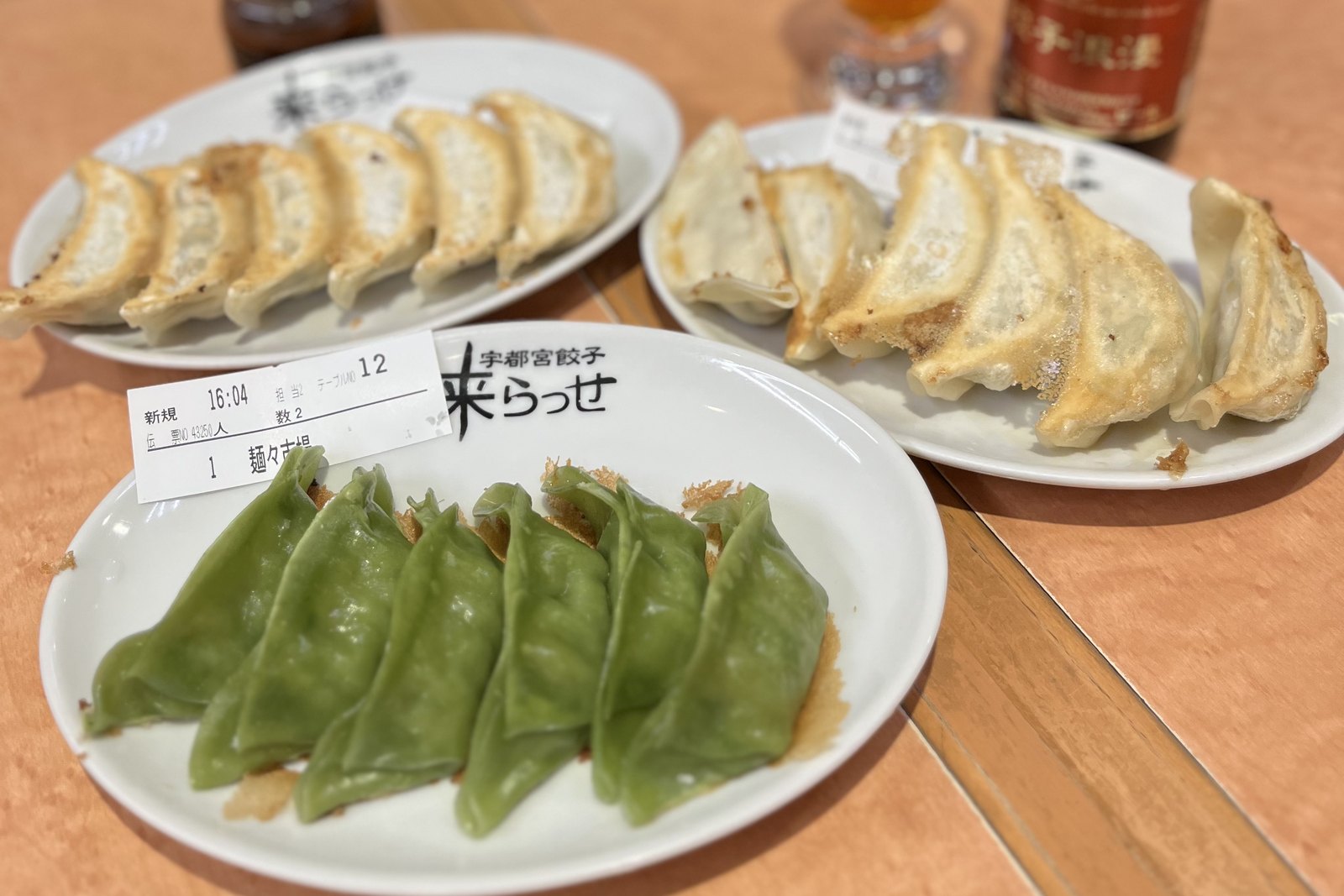
Five well-known Utsunomiya gyoza shops each run their own counter here. They are Minmin, Menmen, Kouran, Ryumon, and Satsuki, although the lineup can change. This is the real gyoza from each shop, cooked to order, so you can order from two or three counters and compare them at the same table.
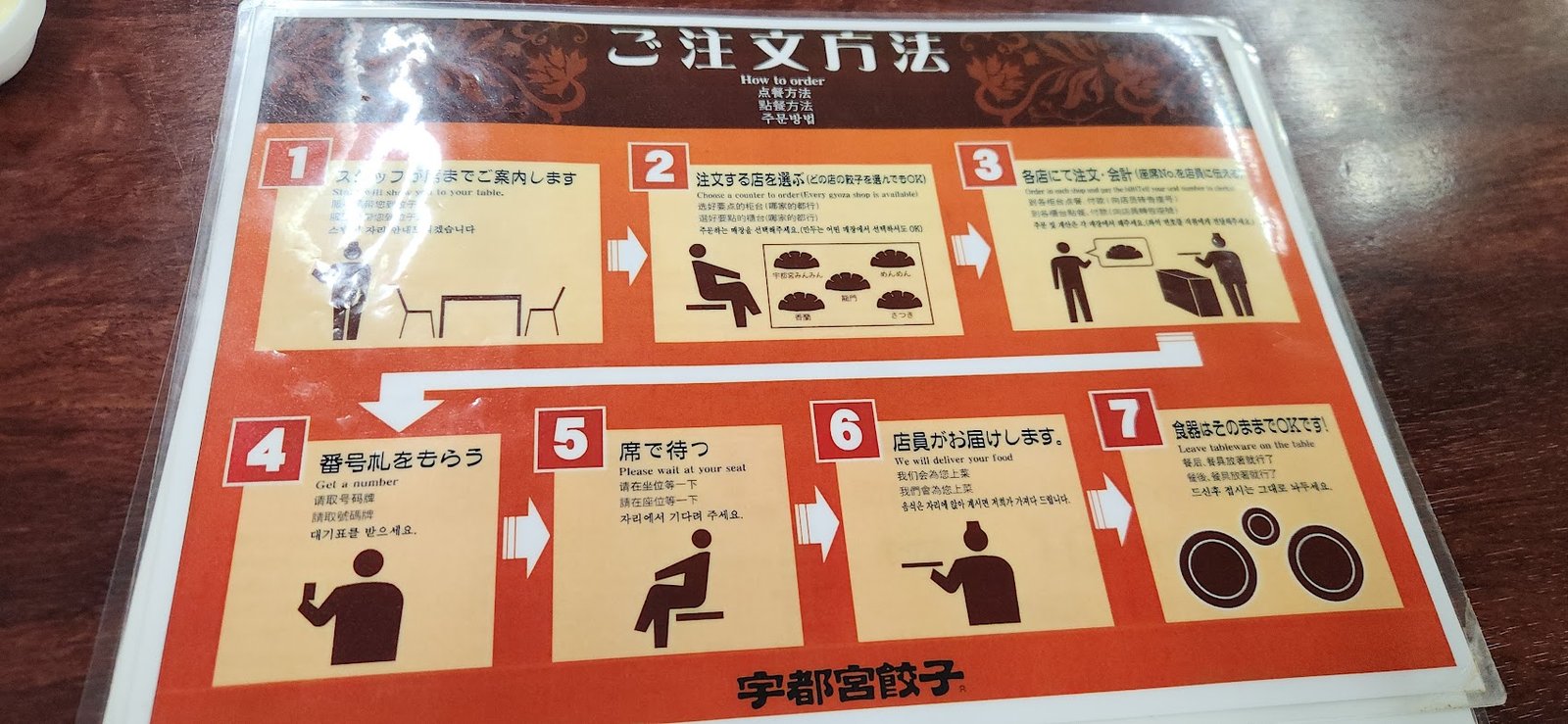
Ordering works like this, and a picture card on each table explains it in English:
- Staff show you to a table. Remember your table number.
- Choose a shop and go to its counter.
- Order and pay at that counter, and tell them your table number.
- Take the number tag they give you and wait at your table.
- Staff bring the gyoza to you.
- When you finish, leave the plates on the table.

A few practical tips: each shop takes one day off during the week on a rotating schedule, so on most weekdays only four counters are open. All five are usually open on weekends, so go on Saturday or Sunday if you want the full set. On busy days a queue forms before the 11:00 AM opening. There is a QR code queue system, but it uses LINE, the messaging app most people use in Japan. If you do not have LINE, ask the staff for a paper ticket.
2. The Daily Menu Restaurant
Most visitors miss this side, and it is arguably the more interesting one. It is a restaurant with its own menu of gyoza from many other shops in the Utsunomiya Gyoza Association, including small neighborhood places without a counter of their own. The menu changes every day, depending on which shops’ gyoza are being served.

The best thing to order here is a mixed plate, often called “All Star Gyoza,” at around ¥550 for about seven pieces. Every gyoza on the plate comes from a different shop, so you can compare wrappers and fillings bite by bite. Trying the same range around the city would take days. You can also order single plates from the day’s menu.
Kirasse Practical Info

| Address | Basement floor, MEGA Don Quijote La Park, 2-3-12 Babadori, Utsunomiya |
| Hours | Shop counters: 11:00 AM to 8:30 PM on weekdays, 11:00 AM to 9:00 PM on weekends Daily menu restaurant: 11:00 AM to 9:00 PM |
| Phone | +81 28-614-5388 |
| Price | Lunch under ¥1,500 per person |
| Payment | Bring cash for the shop counters. Some other areas take cards and IC transit cards. |
The basement also has a shop selling frozen gyoza from member shops, gyoza-flavored snacks, and a surprisingly large range of gyoza souvenirs, such as keychains and plush toys.
Can’t get to Utsunomiya? You can order frozen Utsunomiya gyoza for delivery within Japan, or buy a gyoza-making kit to try the style at home.
One thing to know: every shop at Kirasse also has its own restaurant elsewhere in the city, and some people say the original shops are still a little better, with gyoza served straight from the pan and more atmosphere. That is probably fair. But if your time is limited, Kirasse is the only place in the city where you can taste this range of Utsunomiya gyoza in one meal.
A Simple Gyoza Day in Utsunomiya
If you have a day in Utsunomiya, this is what we would suggest:
- 11:00 AM: Lunch at Kirasse. Order three plates across both sides: one or two from the shop counters, and one mixed plate from the daily menu restaurant.
- 2:00 PM: Walk Gyoza Street. See the queues at Minmin and Masashi, then take the classic photo with the gyoza statue at the station’s west exit.
- 3:00 PM: Coffee or sake. Tochigi also makes sake, which goes well with gyoza if you still have room.
- 6:00 PM: Dinner at your favorite. Pick the shop you liked most at Kirasse and visit its own restaurant. You get variety at lunch and depth at dinner, and you only queue twice instead of six times.
Where to Stay in Utsunomiya
Most visitors come on a day trip, but staying overnight means you can be near the front of the queue at the famous shops (many open at 11:00 AM, and lines form before that) and try dinner places that are hard to fit into a day trip.
Hotels near JR Utsunomiya Station:
- JR East Hotel Mets Utsunomiya: mid-range, directly connected to the station’s west exit
- Richmond Hotel Utsunomiya Ekimae: mid-range, about 4 minutes on foot from the station
- APA Hotel Utsunomiya-Ekimae: budget-friendly, about 3 minutes on foot from the station
- Daiwa Roynet Hotel Utsunomiya: mid-range, about 4 minutes on foot from the station’s east exit
Best Time to Visit Utsunomiya for Gyoza
- Weekends: all five Kirasse counters are usually open. Busier, but livelier.
- Early November: the Utsunomiya Gyoza Festival is the biggest gyoza event of the year, with dozens of shops selling cheap sample plates.
- Spring (March to April): cherry blossoms along the Tagawa River go well with a gyoza lunch.
- Check closing days: most shops close one or two days a week, and the days differ from shop to shop. Major Japanese holidays can mean queues of two hours or more.
Utsunomiya Gyoza FAQ
Is Utsunomiya worth visiting just for gyoza?
Yes, if food is a big part of why you travel. More than 300 shops, a distinctive local style, and the Kirasse format make it unusual. No other city in Japan is set up quite like this for dumplings.
How much gyoza should I order per person?
Locals often eat 20 or more pieces in one meal. Plates are small, usually 6 pieces for ¥250 to ¥500, and the filling is mostly vegetables, so they go down easily. If you want to try several shops, plan on at least 10 to 15 pieces each.
Is Utsunomiya gyoza better than Hamamatsu gyoza?
It comes down to taste. Utsunomiya gyoza are lighter, with more vegetables. Hamamatsu gyoza use more cabbage, are arranged in a circle on the plate, and come with bean sprouts in the middle. The two cities have traded the top spot for household gyoza spending for decades, and neither is backing down.
How do you pronounce Kirasse?
“kee-RAH-sseh,” with four beats. The final “e” sounds like the “e” in “set,” and the double “s” has a short pause. The name means “come on in!” in the local Tochigi dialect.
Can I take Utsunomiya gyoza home?
Yes. The shop in the Kirasse basement sells frozen gyoza from member shops, and most of the famous shops sell frozen packs to take away. They travel fine in a cool bag on domestic flights within Japan. If you are flying abroad, check your home country’s rules on bringing in meat first, because many countries restrict it.
What is the best gyoza shop for first-time visitors?
Kirasse. If you would rather visit one standalone shop, Minmin Honten is the classic choice and has the quickest queue system.
Is Utsunomiya a good day trip from Tokyo?
Yes. It is about 50 minutes each way by shinkansen, the trip is covered by the Japan Rail Pass, and you can easily visit three or four gyoza shops plus the sights near the station in one day.
How much does a gyoza meal in Utsunomiya cost?
Not much. A filling lunch of two or three plates and a drink costs about ¥1,000 to ¥1,800 per person at most shops, including Kirasse. Dinner with beer might reach about ¥2,500.
Final Tips Before You Go
- Bring cash. Some of the most famous shops, Masashi especially, only take cash.
- Use more vinegar than you think. Locals add a lot to their dipping sauce, and they are right.
- Go early or late. Between 12:00 and 1:30 PM, the wait at Minmin or Kouran can be an hour. Arrive at 11:00 AM sharp or around 2:30 PM instead.
- Pace yourself. Trying 15 gyoza across three shops is better than eating 30 at one.