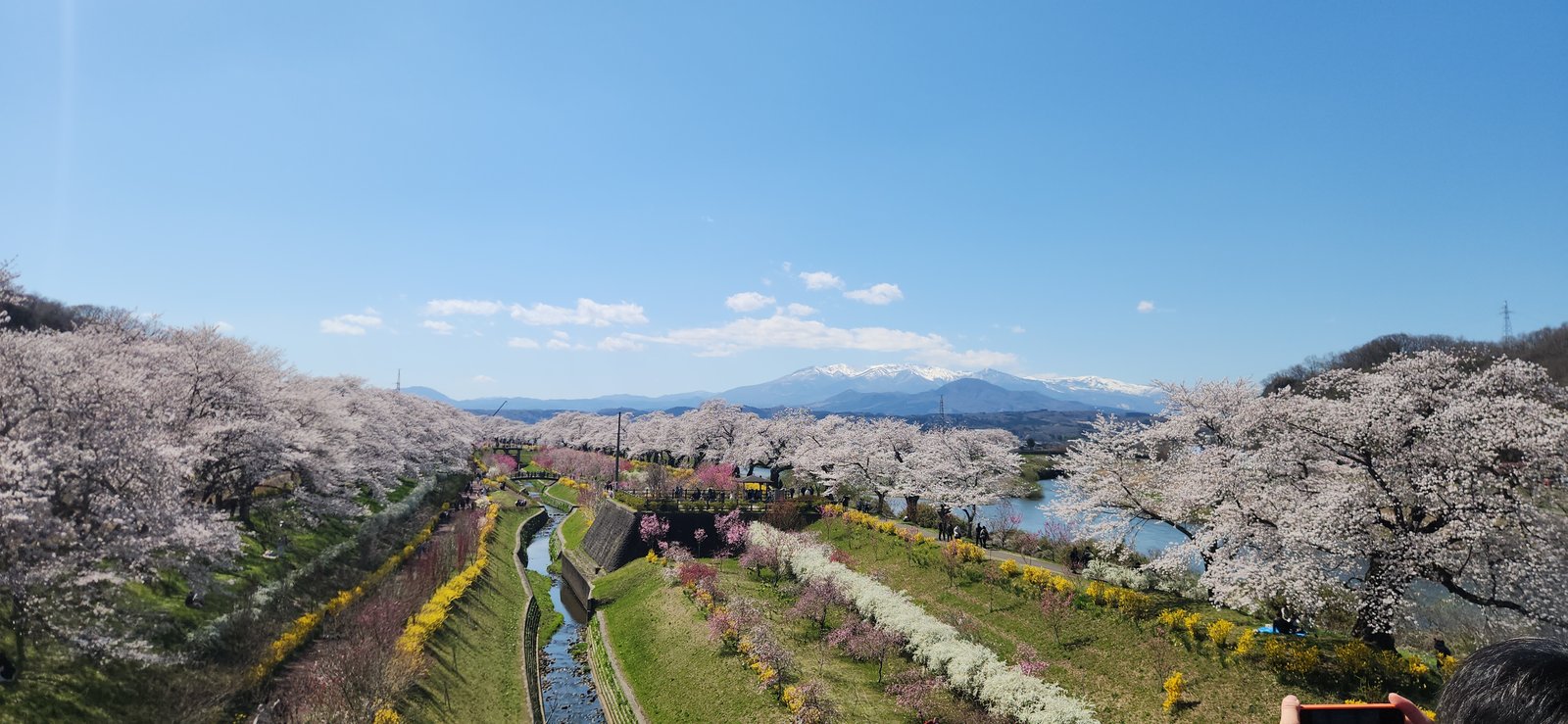
Shiroishigawa Hitome Senbonzakura (白石川堤一目千本桜) was one of the most rewarding sakura areas we visited in Miyagi.
The riverside walk was the strongest part of the day for me. The cherry blossoms hung low, the path continued for a long distance, and even though this is a popular sakura spot, the riverbank was spacious enough that it never felt uncomfortably crowded.
Funaoka Castle Park was also beautiful and absolutely worth visiting, especially for the viewpoint and the sakura around the slope car tracks. But the riverbank walk was so impressive that it became the highlight of the visit.
If you are planning a sakura day trip from Sendai, Matsushima, or elsewhere in Miyagi, I would treat Shiroishigawa Hitome Senbonzakura and Funaoka Castle Park as a paired visit. The riverbank gives you the immersive cherry blossom walk, while Funaoka Castle Park gives you the elevated view.
Quick verdict: is Shiroishigawa Hitome Senbonzakura worth visiting?
Yes, especially if you enjoy scenic walks, photography, and slower cherry blossom days.
This is not a small park where you arrive, take a few photos, and leave. The appeal of Shiroishigawa Hitome Senbonzakura is the length of the sakura corridor. Official information describes Hitome Senbon Zakura as an approximately 8 km stretch of cherry trees along the Shiroishi River through Ogawara and Shibata, with views of the snow-capped Zao mountains during sakura season.
For me, this was more memorable than visiting one single famous tree or one compact sakura park. The blossoms were low, close, and surrounding. We also had a picnic along the riverbank, which made the visit feel more relaxed and atmospheric.
If you are staying in Sendai, travelling by train is highly recommended. The ride to Funaoka Station is manageable, you do not need to worry about parking, and you can start from Funaoka Station and return from Ogawara Station if you want to make it a one-way walk. During peak bloom, you may also be able to catch the special slow-running train service between Funaoka and Ogawara, which makes the train-and-sakura view easier to enjoy.
If you are staying in Matsushima, travelling by car is more convenient. The train route from Matsushima to Funaoka or Ogawara is much less direct, so driving makes more sense if you already have a rental car.
Go for: riverside sakura, photography, walking, picnic atmosphere, mountain-and-river scenery.
Skip if: you do not enjoy walking or only want a very quick sakura stop.
Best use of time: prioritize the riverbank first, then add Funaoka Castle Park if you have enough time.
Our visit at a glance
| Detail | Our experience |
|---|---|
| Date visited | April 8, 2026 |
| Main priority | Shiroishigawa Hitome Senbonzakura / 白石川堤一目千本桜 |
| Added stop | Funaoka Castle Park / 船岡城址公園 |
| Starting side | Funaoka / Shibata side |
| Parking | We parked at 白石川左岸河川敷駐車場 after the right-bank temporary lot was full |
| Route | Riverside walk → Shibata Senokyo Bridge area → Funaoka Castle Park → back down → continued toward Ogawara |
| Time needed | Easily 4–5 hours if visiting both the riverbank and the park slowly |
| Food | We brought supermarket food for a picnic; festival stalls were also available |
| Crowd level | Slightly crowded but manageable; quieter toward Ogawara |
| Best photo memory | Shibata Senokyo Bridge area, with sakura, river, railway, and the Zao mountains |
What is Shiroishigawa Hitome Senbonzakura?
Shiroishigawa Hitome Senbonzakura, also written as Shiroishigawa Tsutsumi Hitome Senbonzakura or 白石川堤一目千本桜, refers to the famous cherry blossom corridor along the Shiroishi River in southern Miyagi.
The name is often translated as something like “a thousand cherry trees at a glance.” In practice, it feels less like one single viewpoint and more like a long riverside sakura walk.
Official information says around 1,200 cherry trees line the Shiroishi River embankment over about 8 km, and the area is known for the contrast between the river, pale pink blossoms, and the snow remaining on the Zao mountain range.
This is also why the place name can be confusing. Some guides focus on Ogawara, some focus on Shibata, and some focus on Funaoka Castle Park. In reality, the experience can include all of them, depending on where you start and how far you walk.
What is Funaoka Castle Park?
Funaoka Castle Park, also called Funaoka Castle Ruins Park (船岡城址公園), is a hilltop sakura spot in Shibata.
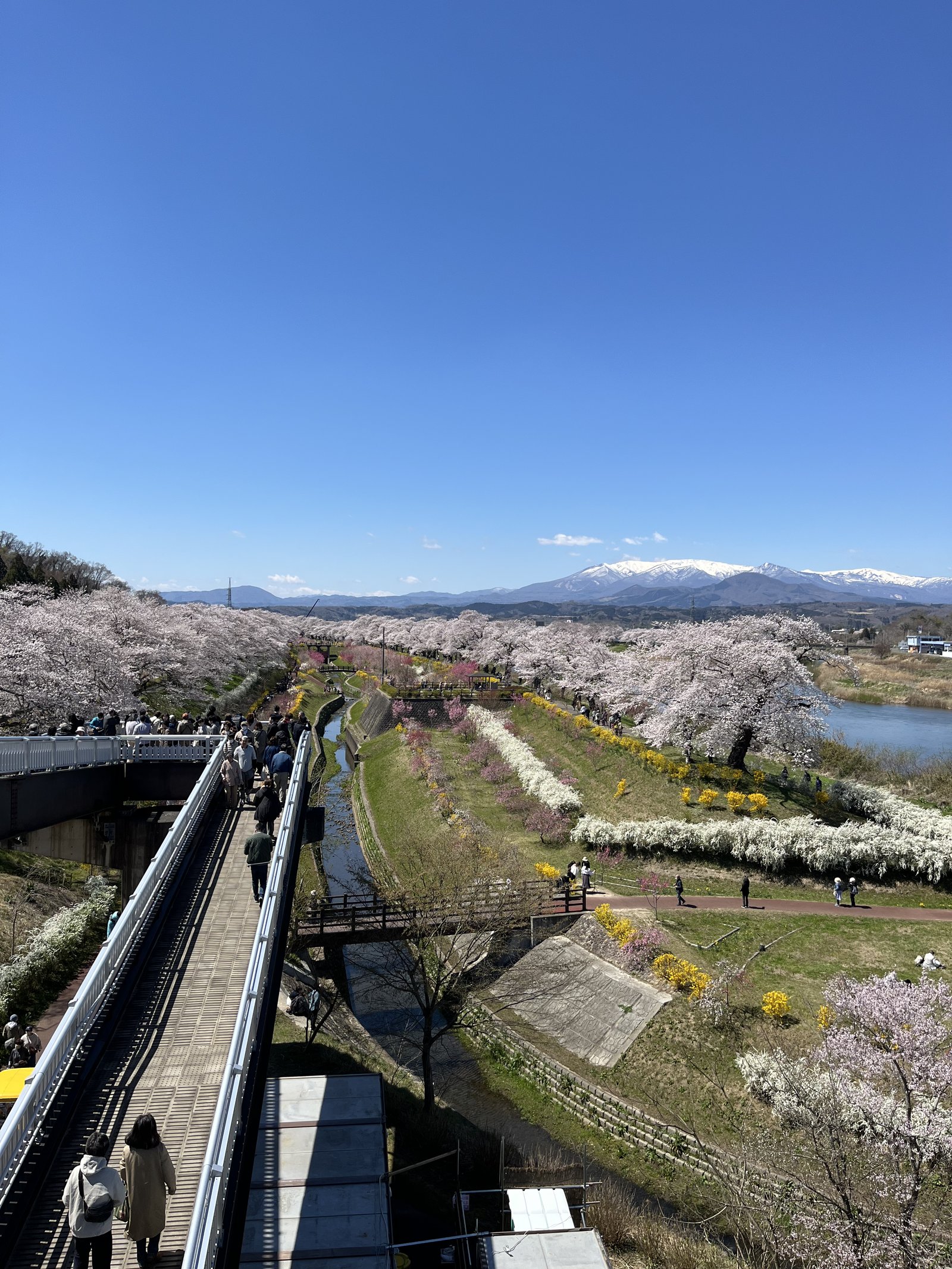
It is close enough to the Shiroishi River that many visitors combine it with the Hitome Senbonzakura riverside walk. The official sightseeing site describes Funaoka Castle Ruins Park as having around 1,300 cherry trees, with views over the 1,200 cherry trees along the Shiroishi River embankment. Together, they create a layered sakura landscape of around 2,500 cherry trees.
I would not treat Funaoka Castle Park as a replacement for the riverbank walk. They feel different.
The riverbank is immersive: you walk beside and under the blossoms. Funaoka Castle Park gives you height, a wider view, and a different photo style.
Should you visit both together?
Yes, if you have enough time.
For me, the riverside walk was the stronger part of the day, but Funaoka Castle Park was still beautiful and worth visiting. The best way to think about it is:
Shiroishigawa riverbank: the main sakura experience.
Funaoka Castle Park: the viewpoint and second highlight.
The riverbank gives you the feeling of being surrounded by cherry blossoms. The park gives you the broader view, plus some photogenic sakura scenes of its own, especially around the slope car tracks.
If you only have around two hours, I would prioritize the riverbank. If you have four to five hours, visit both and give yourself time for photos, a picnic, and the walk up to the park.
Our route: how we visited from the Funaoka side
We visited by car and started from the Funaoka / Shibata side.
Our first parking choice was 白石川右岸河川敷臨時駐車場, but it was already full. We then parked at 白石川左岸河川敷駐車場, which worked well for starting the riverside walk.
From there, our route was:
- Walk along the Shiroishi River sakura corridor.
- Visit the Shibata Senokyo Bridge area.
- Walk up to Funaoka Castle Park.
- Come back down from the park.
- Continue walking along the river toward the Ogawara direction.
We did not walk all the way to Ogawara Station or the Ogawara festival area on this visit, although I had done that on a previous trip.
This route worked well because it let us enjoy the riverbank first, add the viewpoint from Funaoka Castle Park, and then return to the riverside walk afterward.
The riverside walk: the best part of the day
The Shiroishi River walk was the part that made this area stand out.
The cherry blossoms were low and close, so it did not feel like we were only looking at trees from a distance. At many points, the blossoms were right beside us or above us. Because there are so many trees along the river, the walk gave a strong “surrounded by sakura” feeling.
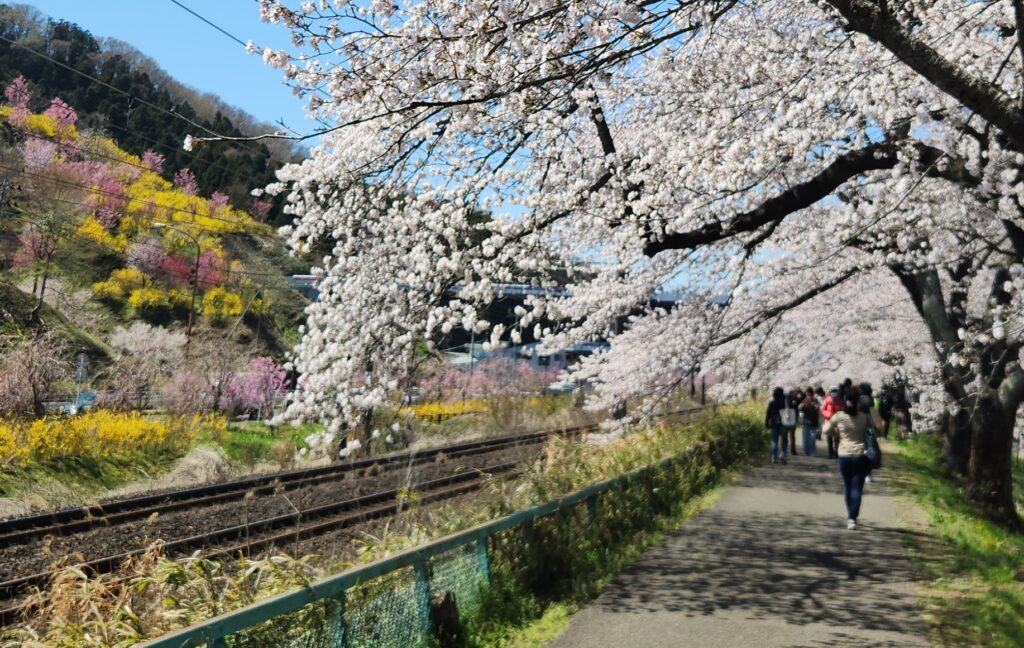
What I liked most was that the scenery kept continuing. Some sakura spots are beautiful but compact, so you take a few photos and then you are done. Here, the path is long enough that the blossoms feel like they keep unfolding as you walk.
It was slightly crowded, but manageable. Around the Funaoka side and near the main access points, there were more people. As we walked toward the Ogawara direction, it felt less crowded.
That made the visit feel much more relaxed than I expected from such a famous cherry blossom area.
The Ogawara side is quieter
If you prefer a quieter atmosphere and do not mind walking farther, the Ogawara side is a good option.
In our experience, the Funaoka / Shibata side felt busier because it is closer to Funaoka Castle Park, Shibata Senokyo Bridge, and many of the popular photo spots. As we walked toward Ogawara, the atmosphere became calmer.
This creates a useful planning choice:
Start from Funaoka Station if you want easier access to Funaoka Castle Park and Shibata Senokyo Bridge.
Start from Ogawara Station if you prefer a quieter riverside start and are okay with a longer walk toward the Funaoka-side highlights.
For people who dislike crowds but enjoy walking, I would seriously consider starting from Ogawara Station and walking toward Funaoka.
The picnic was worth planning for
We brought our own food from a supermarket and had a picnic along the riverbank. If it is your first hanami picnic, see my sakura picnic guide.
This was one of the best parts of the visit. Because the riverbank is long, it was not difficult to find a place to sit. Having food with us also meant we did not need to time the walk around food stalls or queues.
During sakura season, food stalls are usually concentrated around two areas: Sakura Market below Shibata Senokyo Bridge and Shiroishigawa Park near Ogawara Station.
Still, I would bring your own picnic food if you want the most flexibility. The stalls are useful, but the most relaxing experience is being able to stop wherever the view feels right.
Shibata Senokyo Bridge: our best photo spot
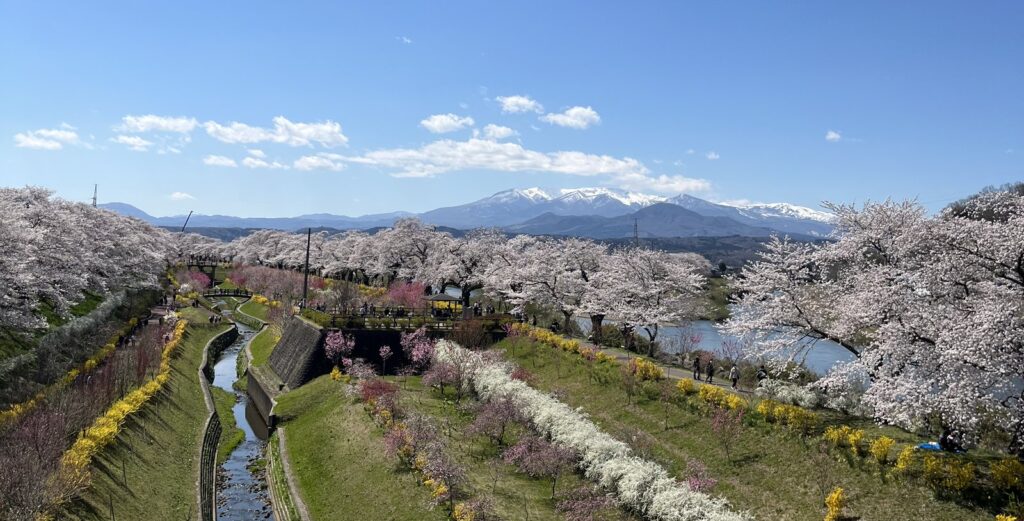
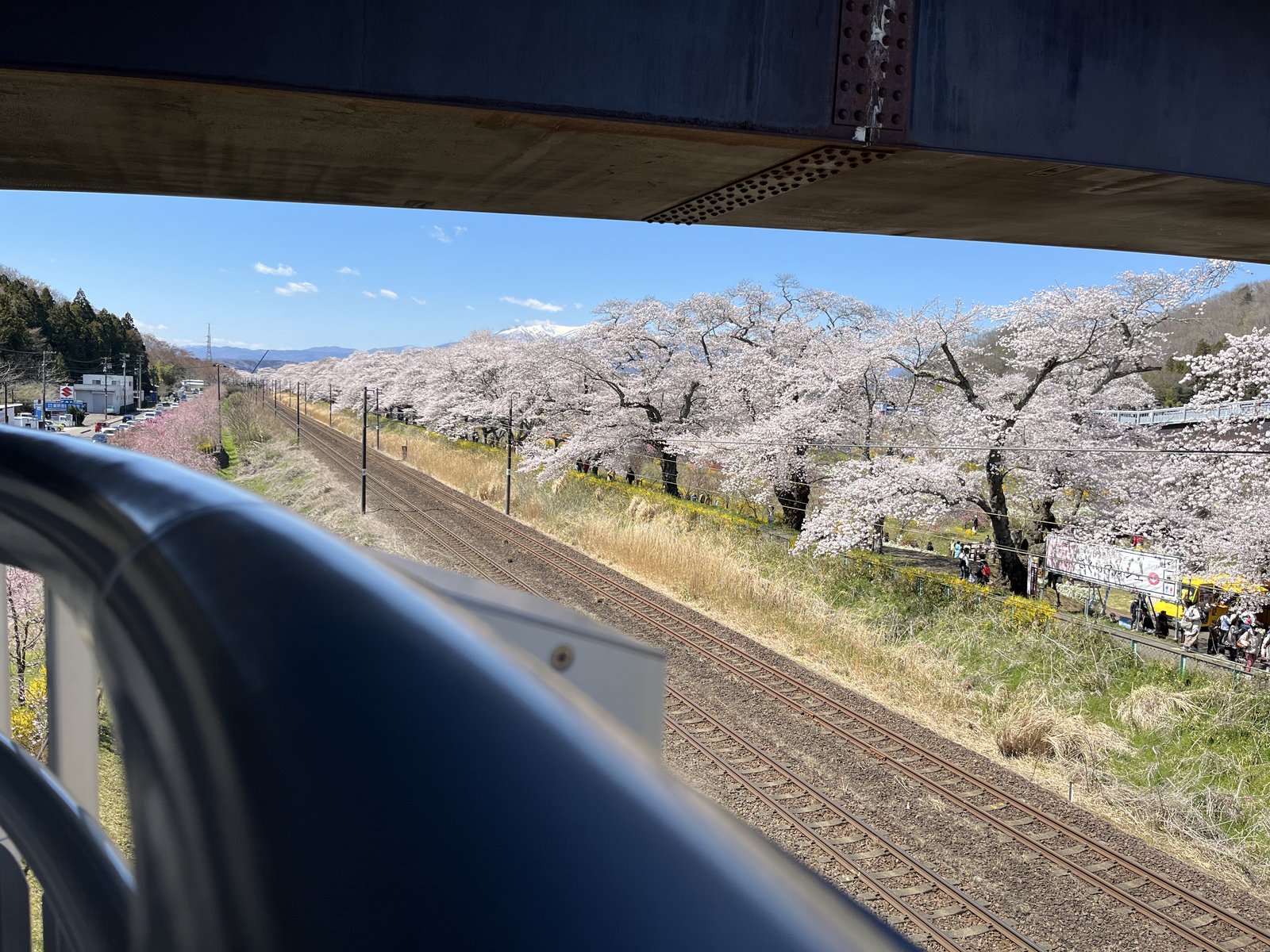
From this area, you can frame the sakura and river in the foreground with the Zao mountain range in the background. Depending on your timing, you may also catch a train passing through the scene.
Shibata Senokyo Bridge is a pedestrian bridge (about 87 metres long, completed in 2015) that crosses over the JR Tohoku Main Line and connects the Shiroishi River embankment with Funaoka Castle Park. Standing on it puts you high enough above the tracks to see the long line of riverbank sakura on one side and the slopes of Funaoka Castle Park on the other.
The train-and-sakura composition is one of the area’s signature photos for a reason. During peak bloom (in 2026, approximately April 1 to April 16), JR East runs trains slowly through this stretch between Funaoka Station and Ogawara Station, roughly between 10:00 and 15:00, so passing trains stay in the scene longer. Check the JR East announcement page for the exact dates of the slow-running operation in your travel year.
For photographers, this is one of the places I would spend extra time. The view changes depending on where you stand, how the light hits the river, and whether a train passes through the scene.
Funaoka Castle Park: still worth going
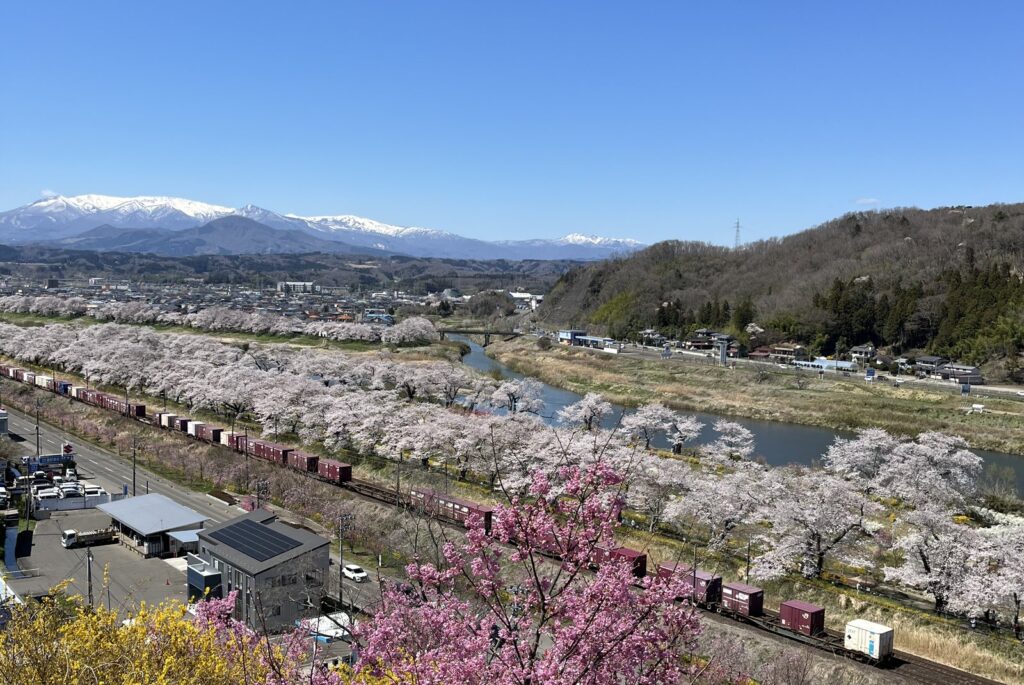
Funaoka Castle Park was not just an “extra” stop. I really enjoyed it.
The park gives you something the riverbank cannot: height. From the upper areas, you can look out over the town, the Shiroishi River, the long rows of cherry trees, and the mountains beyond. It helps you understand the scale of Hitome Senbonzakura in a way that is harder to feel when you are walking beside the river.
The park itself also has beautiful sakura scenes. I especially liked the cherry blossoms around the slope car tracks. Even when the slope car is not running, the tracks with sakura around them are very photogenic.
The walk up to the park was easy for us. I would not avoid Funaoka Castle Park just because you have to walk up. The bigger question is whether you have enough time and energy to add the park after already walking along the river.
About the Funaoka Castle Park slope car
The slope car is a small hillside vehicle that normally connects the lower area of Funaoka Castle Park with the area closer to the top. The official sightseeing site describes it as a short ride that passes through a cherry blossom tunnel during sakura season.
I rode it on a previous visit. The ride is short, but during sakura season it is memorable because it feels like you are moving through the blossoms.
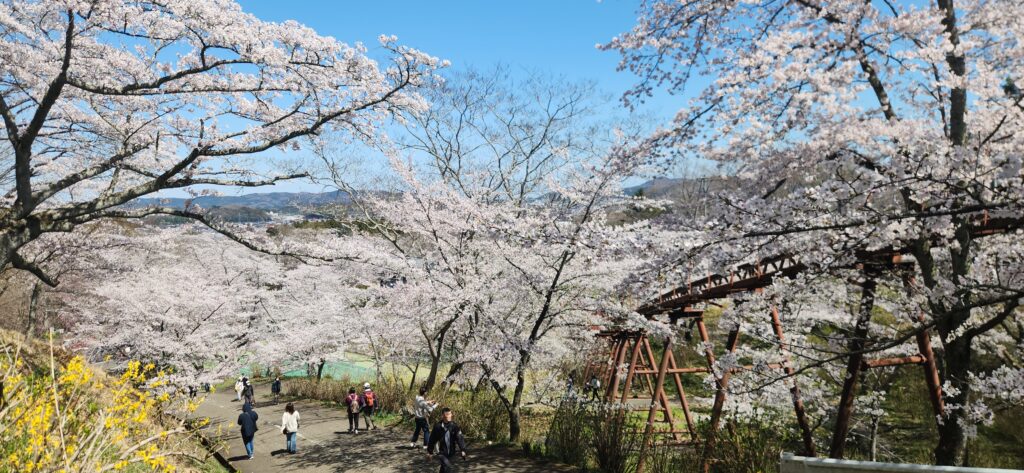
On our 2026 visit, however, the slope car was closed. Shibata tourism information stated that the slope car had been suspended since summer 2025 due to aging vehicles and equipment, and that it would remain closed during the 2026 Shibata Sakura Festival while renewal work was underway.
So I would not build your plan around the slope car unless you confirm it is operating for your travel year. Fortunately, the walk up was easy for us, and I still think Funaoka Castle Park is worth visiting even without the ride.
How crowded was it?
It was popular but manageable.
This is not a hidden sakura spot. During peak bloom and festival season, you should expect other visitors, parking pressure, and traffic around the most popular areas.
That said, the riverbank is long enough that the crowds can spread out. We felt more people around the Funaoka side and near Funaoka Castle Park, but as we continued walking toward the Ogawara direction, the atmosphere became less crowded.
My advice is to arrive earlier than we did. That is what I would do differently next time. An earlier start would make parking less stressful, give more time for photos, and let you enjoy the riverbank before the busiest part of the day.
Parking tips if you are driving
Parking is possible, but you should stay flexible.
We first tried to park at the temporary right-bank riverside parking lot, but it was full. We then parked at the left-bank riverside parking lot instead. It was not too difficult in the end, but near Funaoka Castle Park we saw a lot of traffic waiting for parking.
For 2026, the Shibata Sakura Festival page listed paid festival parking, real-time parking status, shuttle bus information, and traffic guidance. It also advised visitors to use public transportation where possible because congestion was expected during the festival period.
One thing worth knowing: there are actually two separate festivals along this stretch of river, each run by its own town. The Ogawara Sakura Matsuri is run by Ogawara Town on the Ogawara-side riverbank (April 1–14 in 2026), and the Shibata Sakura Matsuri is run by Shibata Town around Funaoka Castle Park and the Funaoka-side riverbank (April 1–16 in 2026, with night light-up and the main food stalls from April 3). They share the same sakura corridor, but parking, shuttles, and event info come from two different town websites, so check both if you are crossing between the two sides.
For a future visit, I would not plan around one exact parking lot only. Have several options ready, check the current-year official parking information, and be prepared to walk from whichever lot has space.
Access from Sendai: train is recommended
For the full train route and station choices, see How to Visit Shiroishigawa Hitome Senbonzakura from Sendai.
If you are staying in Sendai, I would recommend travelling by train.
The biggest reason is simple: you avoid parking. During sakura season, the area around Funaoka Castle Park and the riverside parking lots can become busy, and you may need to adjust if your first parking choice is full.
By train, you can also make the walk one-way instead of needing to return to your car. For example:
Funaoka Station → Shiroishi River walk → Shibata Senokyo Bridge → Funaoka Castle Park → Shiroishi River walk → Ogawara Station
Or, for a quieter start:
Ogawara Station → quieter riverside section → Shibata Senokyo Bridge → Funaoka Castle Park → Funaoka Station
From Funaoka Station, the Shiroishi River embankment is only a minute away. Walk along the embankment for about 15 minutes, and you will reach Shibata Senokyo Bridge. Cross the bridge, and you will reach Funaoka Castle Ruins Park. If you start from Ogawara Station, the Ogawara Sakura Matsuri venue is a 3-minute walk.
For most first-time visitors who want to include Funaoka Castle Park, I would start from Funaoka Station. For visitors who prefer a quieter riverside walk and do not mind walking farther, Ogawara Station is a good starting point.
Access from Matsushima: car is better if you have one
If you are staying in Matsushima, I would lean toward visiting by car if you have access to one.
We visited while staying at Hotel Matsushima Taikanso and returned there afterward, and driving made the day much easier. By train, the route from Matsushima to Funaoka or Ogawara takes about 90 minutes one way.
So my practical recommendation is:
- Staying in Sendai: take the train.
- Staying in Matsushima with a car: drive.
- Staying in Matsushima without a car: check the route carefully before committing, because the travel time may feel long compared with the time you want to spend at the sakura area.
If you are already planning a wider Miyagi itinerary by car, Shiroishigawa Hitome Senbonzakura fits well as a sakura-focused day trip from Matsushima. Just be prepared for sakura-season parking, especially around Funaoka Castle Park.
How long should you spend?
If you only want a short look at the riverbank, you could spend around two hours. But I would not recommend rushing this area if you can avoid it.
For our style of visit (walking the riverbank, taking photos, going up to Funaoka Castle Park, coming back down, continuing the riverside walk, and having a picnic), four to five hours felt very reasonable.
| Time available | Suggested plan |
|---|---|
| 1–2 hours | Funaoka Station → riverbank → Shibata Senokyo Bridge → return |
| 2–3 hours | Funaoka Station → riverbank → Shibata Senokyo Bridge → Funaoka Castle Park → return |
| 4–5 hours | One-way walk between Funaoka and Ogawara with Funaoka Castle Park |
| Half day | Slow walk, photos, picnic, and both sides |
If your schedule is tight, choose the riverbank first. That is the part I would least want to miss.
Is it worth visiting outside peak bloom?
I think it can still be worth visiting slightly outside peak bloom because there are so many cherry trees.
Of course, full bloom will be the most impressive. Sakura timing changes each year, and weather can shorten or extend the best period. But because the area is so large, it may still feel rewarding even if not every tree is perfect.
Checking bloom timing before you go
Bloom timing in southern Miyagi usually falls in early to mid-April, but the peak shifts by a week or so each year. A few sources I would check before locking in transport:
- Ogawara Town live camera (Ogawara Tourism Association): the riverbank live camera is updated only during the bloom period and gives the clearest current-day view.
- Weathernews Hitome Senbonzakura page: shows the official bloom forecast and the running daily status.
- The official town pages: Ogawara Town and Shibata Town both publish daily bloom-status updates during the festival period.
One photo spot worth noting in advance: Niragami-zeki, a weir roughly halfway between Ogawara and Funaoka stations that is often shown in famous wide-angle photos of Hitome Senbonzakura. As of the 2026 festival, Niragami-zeki is under renovation work and scaffolding is installed, so visitors cannot approach the viewing area. Check the current-year status if this spot is a priority for you.
How does it compare with other sakura spots?
Among the sakura places we visited in Miyagi, this was one of the strongest.
Compared with Nishi-koen night sakura in Sendai, Shiroishigawa Hitome Senbonzakura felt much more scenic and expansive. Nishi-koen had more of a local city-park atmosphere, especially at night, so it offers a different kind of experience.
Compared with smaller hidden sakura spots like Ishibayashi, this area was much more dramatic. The blossoms felt lower, closer, and more abundant, and the river-and-mountain scenery added a lot.
Compared with Miharu Takizakura, I would personally choose Shiroishigawa Hitome Senbonzakura. Miharu Takizakura is famous and historically important, but this riverside area gave us a fuller experience: walking, picnic, photography, and changing scenery over several hours.
That does not mean everyone should skip Miharu. It depends on whether you prefer seeing one iconic tree or spending half a day inside a larger sakura landscape.
Best for / skip if
Best for
This area is best for travellers who:
- Love cherry blossoms and want a longer hanami experience.
- Enjoy scenic walks rather than quick photo stops.
- Like photography.
- Want a sakura day trip from Sendai or southern Miyagi.
- Enjoy picnic-style travel.
- Want a famous sakura spot that still has enough space to feel manageable.
Skip if
You may want to skip or shorten the visit if:
- You do not like walking.
- You are travelling with someone who struggles with slopes or long outdoor routes.
- You only have time for a very quick stop.
- You dislike festival-season traffic and do not want to use public transport.
- You are visiting far outside sakura season and only care about peak bloom scenery.
What I would do differently next time
I would arrive earlier.
We still had a wonderful visit, but an earlier start would make everything easier: parking, photos, walking pace, and time at both the riverbank and Funaoka Castle Park.
I would also bring picnic food again. That was absolutely worth it. The stalls are useful during the festival, but having our own food let us choose the spot and timing ourselves.
Finally, I would keep the plan flexible. This area has several access points, parking areas, and walking-route options. The best experience is not about following one perfect route. It is about giving yourself enough time to enjoy the riverbank slowly.
Final recommendation
Shiroishigawa Hitome Senbonzakura and Funaoka Castle Park work very well as a paired visit during sakura season.
The riverbank was the highlight for me. The blossoms were low, close, and seemingly endless, and the long walk made the area feel spacious even though it was popular. Funaoka Castle Park added a beautiful second perspective, especially with the viewpoint over the river and the photogenic sakura around the slope car tracks.
If you only have limited time, prioritize the Shiroishi River walk. If you have half a day, add Funaoka Castle Park, bring food for a picnic, and let this become one of your main sakura experiences in Miyagi.
FAQ
Is Shiroishigawa Hitome Senbonzakura the same as Funaoka Castle Park?
No. They are separate but nearby sakura areas. Shiroishigawa Hitome Senbonzakura refers mainly to the long cherry blossom corridor along the Shiroishi River, while Funaoka Castle Park is a hilltop park in Shibata. They are often visited together because the park gives a viewpoint over the riverbank sakura.
Should I start from Funaoka Station or Ogawara Station?
Start from Funaoka Station if you want easier access to Funaoka Castle Park and Shibata Senokyo Bridge. Start from Ogawara Station if you prefer a quieter riverside start and do not mind a longer walk toward the Funaoka-side highlights.
How long do I need for Shiroishigawa Hitome Senbonzakura and Funaoka Castle Park?
I would allow four to five hours if you want to enjoy the riverbank, visit Funaoka Castle Park, take photos, and have a picnic. If you only have two hours, prioritize the riverside walk.
Is Funaoka Castle Park worth visiting if the slope car is closed?
Yes. The slope car is a nice sakura-season experience when running, but the walk up was easy for us, and the park is still worth visiting for the viewpoint and sakura scenery.
Is this a good sakura day trip from Sendai?
Yes. If you are staying in Sendai, I recommend taking the train. The ride is manageable, and you can start from one station and return from another instead of worrying about parking.