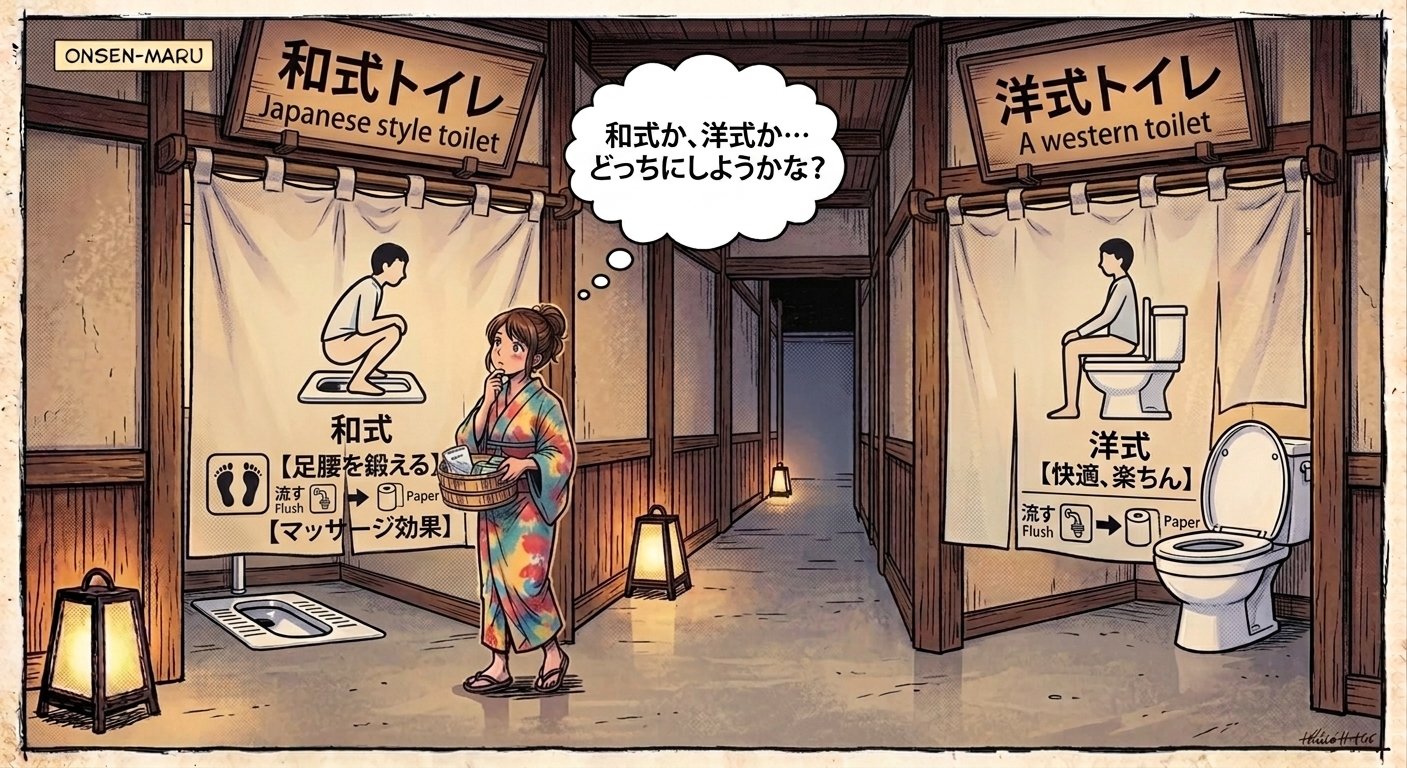
Japan is famous for high-tech washlet toilets, and in most tourist-facing hotels and many ryokan, western toilets are far more common than Japanese-style toilets.
That said, Japanese-style toilets still exist. You may encounter them in older buildings, rural public facilities, parks, temples, stations, or occasionally in a specific room type at an older ryokan.
This guide is not meant to make Japanese-style toilets sound like a normal problem at most ryokan. In our own travels, we have stayed at many ryokan, and Nekonaki Onsen Izutsuya was the only one where our in-room toilet was Japanese-style. But because it surprised us, it is still a useful detail for foreign travellers to understand before booking.
What Is a Japanese-Style Toilet?
A Japanese-style toilet usually means a squat-style toilet built into the floor. It is different from a western toilet, where you sit on a raised seat.
Some travellers do not mind using one. Others strongly prefer western-style toilets. I am in the second group.
The important point is not that Japanese-style toilets are everywhere. They are not. The point is that they can still appear in specific older buildings or room types, and they may surprise you if you have never seen one before.
What Is a Western Toilet?
A western toilet is the seated toilet that many travellers are used to. In Japan, western toilets are often very modern and may include washlet functions such as heated seats, bidet spray, and automatic flushing.
In newer hotels, airports, major stations, department stores, restaurants, and many ryokan, western toilets are very common.
When booking accommodation, the wording can vary. You may see terms like western toilet, washlet, heated bidet toilet, toilet with washing function, or bath and toilet included.
Why This Matters for Ryokan Stays
Ryokan rooms can vary more than hotel rooms. One room type may have a full bath and western toilet. Another may have only a toilet. Another may rely more on shared facilities.
This does not mean older ryokan usually have Japanese-style toilets. Based on our experience, that would be misleading. It simply means you should check the exact room type, especially if the building is older or the room description is vague.
At Nekonaki Onsen Izutsuya, our annex room had a Japanese-style in-room toilet. There was a western-style public toilet nearby, which helped, but I still found the in-room setup uncomfortable. Later, when I checked the official website again, I noticed that some main building Japanese-style rooms are listed with bath and heated bidet toilet. That changed how I viewed the ryokan: the issue was not the whole property, but the specific room type we booked. Room facilities can also change when inns renovate, so it is always worth checking the latest room descriptions and recent reviews rather than relying only on an old experience.
How to Check the Toilet Type Before Booking
When booking accommodation in Japan, look for room facility wording carefully.
Useful words and phrases include:
- Western toilet
- Washlet
- Heated bidet toilet
- Heated toilet seat
- Private toilet
- Shared toilet
- Japanese-style toilet
- Toilet in room
- Room with bath and toilet
- Room without bath / toilet
If the booking page only says “toilet” but does not say western toilet or washlet, and toilet type matters to you, ask the property directly.
What to Ask the Ryokan
A simple message is enough:
Hello, I am considering booking this room. Could you please confirm whether the toilet inside the room is western-style or Japanese-style?
If you need a western toilet, be direct:
I would like to book a room with a western-style toilet or heated bidet toilet. Which room type should I choose?
This is better than assuming and being surprised after check-in.
What If Your Room Has a Japanese-Style Toilet?
First, check whether there is a western-style toilet elsewhere in the building. In our Izutsuya stay, there was a public western toilet nearby, which made the situation easier.
Second, decide whether this is a minor inconvenience or a major comfort issue for you. For one night, you may be okay using a nearby public western toilet. For multiple nights, it may become frustrating.
This is especially important if you are travelling with older family members, young children, mobility concerns, or anyone who strongly prefers western toilets.
Are Japanese-Style Toilets Common in Japan?
They are less common than they used to be in many tourist-facing places, but they have not disappeared.
You may still find them in:
- Older public buildings
- Rural public toilets
- Parks
- Older train stations
- Temple or shrine facilities
- Older restaurants
- Some older accommodation or specific room types
- Mountain or countryside areas
In major cities, newer buildings, and many accommodation facilities, western toilets are usually easy to find.
Should This Stop You from Booking an Older Ryokan?
Usually, no.
Older ryokan can be wonderful. They may have better food, more character, kinder service, and better value than modern hotels. A Japanese-style toilet in one room type does not mean the whole ryokan is uncomfortable.
The better lesson is to book carefully. Check the room facilities, compare room types, and ask if the wording is unclear.
For me, a Japanese-style toilet in the room is a real downside. I would still stay somewhere like Izutsuya again, but I would choose a room with a western-style / heated bidet toilet if available.
Best Booking Strategy
If toilet type matters to you, follow this order:
- Check the room description.
- Look at room photos carefully.
- Search reviews on Google, TripAdvisor, Booking.com, Rakuten, or Jalan for words like “toilet,” “washlet,” “bathroom,” or “shared toilet.”
- Compare different room types at the same ryokan.
- Contact the property if unclear.
Final Thoughts
Japanese-style toilets are not something I would expect in most ryokan rooms, but they are still worth knowing about.
The issue is not whether a ryokan is good or bad. It is whether the room facilities match what you need to feel comfortable.
For rural Japan travel, especially when booking older inns or cheaper room types, this is one of those small practical details that can make a big difference.
FAQ
Are Japanese-style toilets common in ryokan rooms?
Not in our experience. We have stayed at many ryokan, and our Izutsuya annex room was the only one where the in-room toilet was Japanese-style. But room facilities vary, so it is still worth checking.
Are Japanese-style toilets still common in Japan?
They are less common in newer tourist-facing places, but you may still find them in older buildings, rural areas, parks, stations, and some specific accommodation room types.
Do all ryokan rooms have western toilets?
No. Room facilities vary. Some rooms have western toilets, some have heated bidet toilets, some use shared toilets, and a few may still have Japanese-style toilets.
How can I avoid booking a room with a Japanese-style toilet?
Check the room description carefully and contact the property if it is unclear. Ask specifically whether the room has a western-style toilet or heated bidet toilet.
Are washlets the same as western toilets?
A washlet is usually a western-style seated toilet with bidet or heated-seat functions. But not every western toilet has all washlet features.