Quick Answer
Most major expressways in Japan are toll roads.
You can usually pay with ETC, cash, or credit card depending on the lane and tollgate, but the process is much smoother if you understand the basic lane types before you drive.
For a short trip, tolls may feel like an annoying extra cost. For a longer rural route, they can be worth it because they save time and make bigger distances realistic.
That was our experience in Tohoku and Tochigi. We did not use an ETC card, but we used expressways often because the route covered long distances. The tolls felt a bit expensive, but they also helped make the itinerary possible.
What Are Expressways in Japan?
Japan’s expressways are the high-speed road network connecting cities, regions, and rural areas.
They are especially useful when your itinerary covers long distances or several prefectures. For example, a road trip through Tochigi, Fukushima, and Miyagi can involve two- to three-hour driving days even with expressways. Without them, the same route can become much slower.
Expressways are not just “faster local roads.” They often include interchanges, toll gates, service areas, parking areas, restrooms, food courts, shops, and sometimes gas stations.
For rural Japan travel, expressways can be the difference between a relaxed travel day and spending too many hours on local roads.
Why Are Expressway Tolls So Expensive?
Japan’s expressway tolls can surprise first-time visitors.
If you are used to free highways, the cost may feel high. But for rural travel, the tradeoff is often time and convenience.
Tolls may be worth paying if they help you:
- Reduce a long driving day
- Reach rural accommodation before dinner
- Visit more than one countryside stop in a day
- Avoid slow city or mountain roads
- Build a wider itinerary across multiple prefectures
For our route, the tolls were not cheap, but they helped us cover the distance between Tochigi, Fukushima, and Miyagi without making the trip feel impossible.
What Is ETC?
ETC stands for Electronic Toll Collection. It is Japan’s automatic cashless toll payment system for expressways.
Instead of stopping at a toll booth to take a ticket or pay, a car with a working ETC onboard device and an inserted ETC card can pass through ETC lanes. The toll is recorded automatically to the card.
For foreign visitors using a rental car, ETC usually involves two separate things:
- The ETC onboard device already installed in the rental car
- The ETC card, which you may need to rent from the rental car company
Do not assume that the car having an ETC device means you can use ETC lanes. You still need a valid ETC card inserted correctly. Also, do not insert your normal credit card into the ETC device. It will not work as an ETC card.
If you rent an ETC card from the rental company, the expressway tolls are usually calculated from the card record and settled when you return the car. ETC is not required for every road trip, but it makes toll gates much smoother if you use expressways often.
How Toll Gates Work Without ETC
If you do not have ETC, look for the general lane.
The Japanese sign for the general lane is:
一般
In my experience, general lanes are usually shown with green signs, while ETC lanes are usually shown with purple signs. This is a helpful visual cue when you are approaching a tollgate, especially if you cannot read the Japanese quickly.
However, do not rely on colour alone. Always check the wording too. For non-ETC payment, you want a lane marked 一般 or a lane that clearly allows general traffic.
At many expressway entrances, you take a ticket from the machine. Keep this ticket carefully. At the exit, you hand over the ticket and pay the toll.
Depending on the tollgate, payment may be possible by cash, credit card, toll collection machine, or staffed booth.
Even if credit cards are often accepted, I would still carry some Japanese yen. Some tollgates or machines may not handle foreign cards smoothly, and having cash reduces stress.
The basic process is:
- Enter through the general lane.
- Take the ticket.
- Keep the ticket safe.
- Exit through the general lane or toll collection machine lane.
- Hand over the ticket or insert it into the machine.
- Pay the toll.
- Continue driving.
How Toll Gates Work With ETC
If your rental car has an ETC device and you have a valid ETC card inserted, you can use ETC lanes. The toll is recorded automatically, and if you are using a rental ETC card, the tolls are usually settled when you return the car.
The main benefits are:
- No stopping to take a ticket
- No cash handling at the booth
- Faster tollgate experience
- Easier payment record
- Eligibility for some ETC discounts or regional passes
ETC is not mandatory for every route, but it is very convenient if you use expressways often.
Common Toll Lane Types
ETC Lane
Use this only if your car has a working ETC device and a valid ETC card inserted.
On the road, ETC lanes are marked with ETC. In many places, the ETC signs are also purple, which makes them easier to spot before you are close enough to read all the details.
General Lane
Use this if you are paying by cash or credit card.
Japanese sign: 一般
In many tollgate areas, general lanes use green signs. If you do not have ETC, this is usually the colour and wording you want to look for.
ETC / General Lane
This mixed lane may accept both ETC and non-ETC users. You may see it marked as ETC / 一般. Be careful because vehicles ahead may stop, even if you are using ETC.
General Toll Machine Lane
Some exits use an automatic toll collection machine instead of a staffed booth. These may be marked with wording such as 一般精算機, meaning a general settlement/payment machine lane.
If you are nervous about machines, choose a staffed general lane when available. If you have to use a machine, take your time and follow the screen or staff guidance.
ETC-Only Tollgate or Smart IC
Some entrances and exits are ETC-only. These are different from normal tollgates. If you do not have ETC, you should not plan to use them.
This is one reason ETC can be useful on an unfamiliar route.
How to Identify the Right Toll Lane Quickly
When you approach a tollgate, start looking for the lane signs early. Do not wait until the last moment to choose your lane.
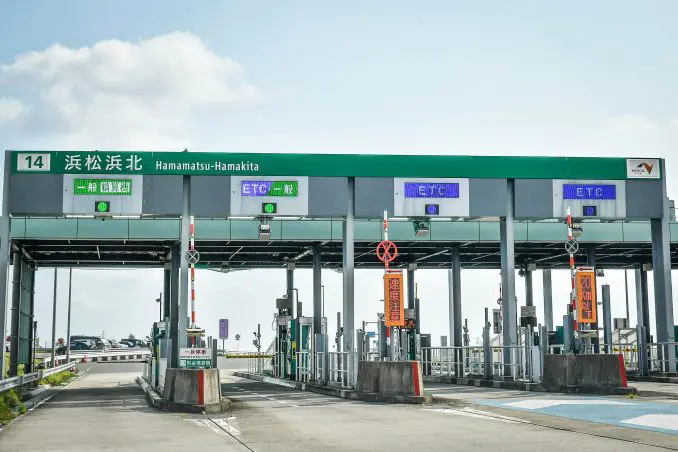
A useful beginner rule is:
- ETC or ETC専用 (purple): ETC lane. Use only if your ETC card is inserted and working.
- 一般 (green): general lane. Use this if you are paying by cash or credit card.
- ETC / 一般 (purple and green side by side) : mixed lane. Both ETC and non-ETC vehicles may use it, but traffic ahead may stop.
- 一般精算機: general toll machine lane. This is for non-ETC payment at a machine.
This colour pattern matched the ETC and general lanes we encountered on our rental-car trips, and it is also commonly described in Japan driving guides. Still, the safest approach is to use the colour as a quick visual cue and then confirm the actual lane label.
Official expressway guidance focuses on the lane labels: Central Nippon Expressway explains that drivers paying by cash or credit card should use lanes marked 一般, while ETC users should use lanes marked ETC. A Japan driving guide from Live Japan also describes ETC lanes as purple and general lanes as green, which matches what we saw on the road.
What Happens If You Accidentally Approach the Wrong Lane?
Do not panic, but do not force your way through.
If you do not have ETC, avoid ETC-only lanes. If you make a mistake, follow the posted instructions and staff guidance. Do not reverse in a toll lane unless instructed, because that can be dangerous.
Before entering an interchange, slow down, read the lane signs early, and choose the correct lane.
For first-time drivers, this is one of the most useful habits: decide your lane early, not at the last second.
Can You Estimate Tolls Before the Trip?
Yes. You can use official expressway route search tools to estimate tolls between interchanges.
The most useful starting point is the official NEXCO Drive Plaza expressway toll / route search:
NEXCO Central also has an English Drive Compass toll and route search tool:
The challenge is that these tools usually work best when you know the expressway interchange names, not just the sightseeing destination. Google Maps can help you identify the approximate route and nearby interchanges, but official toll calculators are better for checking the actual toll.
When planning, estimate tolls for your biggest driving days, not every small movement. Focus on the long legs where toll cost matters most, such as moving between prefectures or choosing between a much slower local-road route and a faster expressway route.
When Tolls Are Worth Paying
The real question is not simply “Should I drive?” It is whether the expressway is worth paying for compared with the local-road route.
Tolls are more likely to be worth it when:
- The expressway saves a meaningful amount of time compared with local roads
- Your route covers long distances or multiple prefectures
- The local-road route would be slow, winding, or tiring
- You need a more predictable arrival time, such as before a ryokan dinner or hotel check-in window
- You are trying to combine distant stops in one day
- You have limited daylight, especially in winter or on a packed sightseeing day
- Avoiding local-road traffic makes the drive less stressful
Some reasons for renting a car, such as carrying luggage or visiting rural areas, are not automatically reasons to pay for a toll road. You can still drive local roads with luggage. The toll-road decision depends on whether the expressway gives you enough time saving, predictability, or comfort to justify the cost.
For our Tohoku and Tochigi route, that was often the case. The car gave us flexibility, but the expressways made the longer distances manageable.
When You Might Avoid Expressways
You might avoid expressways if:
- The toll is high and the time saving is small
- The local road is scenic and not too slow
- You are only driving a short distance
- You want a slower countryside drive
- Your destination is not near an expressway interchange
- You are trying to reduce trip costs
On some rural days, the local road may actually be the better experience. The point is not to use expressways automatically. The point is to compare the time saved with the toll cost.
ETC Discounts and Regional Passes
Some toll discounts require ETC.
Examples can include late-night discounts, holiday discounts on eligible rural expressway sections, and regional expressway passes for foreign visitors.
This is where toll planning and ETC planning overlap. If you are only making one or two short toll-road trips, the discount may not matter. If you are doing a longer route across Tohoku, Hokkaido, Kyushu, or another driving-heavy region, it is worth checking whether a pass fits your itinerary.
For Tohoku, the main option is the Tohoku Expressway Pass (TEP), which is still offered. It gives foreign visitors unlimited use of most NEXCO East expressways in Aomori, Akita, Iwate, Yamagata, Miyagi, and Fukushima for 4 to 8 days. Since October 2024 it has been priced per day (for example, around ¥8,500 for 4 days in a standard car). You need a non-Japanese passport, a rental car from a participating company in Tohoku, and an ETC card. Note that Tochigi is not covered: the pass area ends around Shirakawa in Fukushima. Prices and conditions can change, so confirm with your rental company when booking.
Service Areas and Parking Areas
Japan’s expressway service areas can be surprisingly useful.
They are not just gas stops. Many have restrooms, food, souvenirs, vending machines, regional snacks, and sometimes very good views.
On a long driving day, do not treat breaks as wasted time. Build them into the route.
For a two- to three-hour drive, I would still plan at least one short stop if timing allows, especially if you are new to driving in Japan.
Final Recommendation
Japan’s expressway tolls can feel expensive, but they often make rural itineraries more realistic.
For city-only travel, you probably do not need to think about them much. For a rural rental-car route, especially across multiple prefectures, tolls become part of the real cost of the trip.
My advice is simple:
Estimate the big toll legs before you go, carry cash even if you expect to use a card, consider ETC for expressway-heavy routes, and treat tolls as part of the tradeoff for seeing more of rural Japan.
FAQ
Can I drive on Japanese expressways without ETC?
Yes, in many cases you can use general lanes and pay by cash or credit card. However, some entrances/exits are ETC-only, so check your route carefully if you do not have ETC.
What does 一般 mean at a toll gate?
一般 means general lane. Use this lane if you are not using ETC. In many tollgate areas, these general lanes are also shown with green signs.
What colour are ETC lanes in Japan?
In our experience, ETC lanes are usually shown with purple signs, while general lanes are usually shown with green signs. This is a useful visual cue, but always confirm the actual wording on the lane sign before entering.
Can I pay expressway tolls by credit card in Japan?
Often yes, but not always at every tollgate or machine. Carry Japanese yen as backup.
Are Japan expressway tolls worth it?
For long-distance rural routes, often yes. For short drives or city travel, maybe not. Compare the time saved with the cost.
Do I need ETC for toll discounts?
Many expressway discounts and regional passes require ETC. Check the conditions before relying on a discount.